Why Oceanside's Coast Is Hard on Your Carpet
If you live within a few miles of the water in Oceanside, your carpet faces challenges that homes inland never deal with. Beach sand, salt air residue, and marine-layer humidity all team up to grind down fibers, trap moisture, and leave that gritty, never-quite-clean feeling underfoot. Understanding what's actually happening is the first step to fixing it — and to keeping it from coming back.
Coastal carpet cleaning in Oceanside isn't just regular cleaning done more often. The combination of abrasive silica sand particles, salt air, and high relative humidity creates a specific kind of wear that a quick vacuum can't touch. This guide walks through exactly how sand and dust affect your carpet, the warning signs to watch for, a DIY routine that genuinely helps, and when it's time to bring in a local pro.
We see this every week across Oceanside neighborhoods — from beachfront rentals near Pacific Coast Highway to family homes inland toward Camp Pendleton. The patterns are consistent, and so are the solutions.
How Coastal Sand Wears Down Carpet Fibers
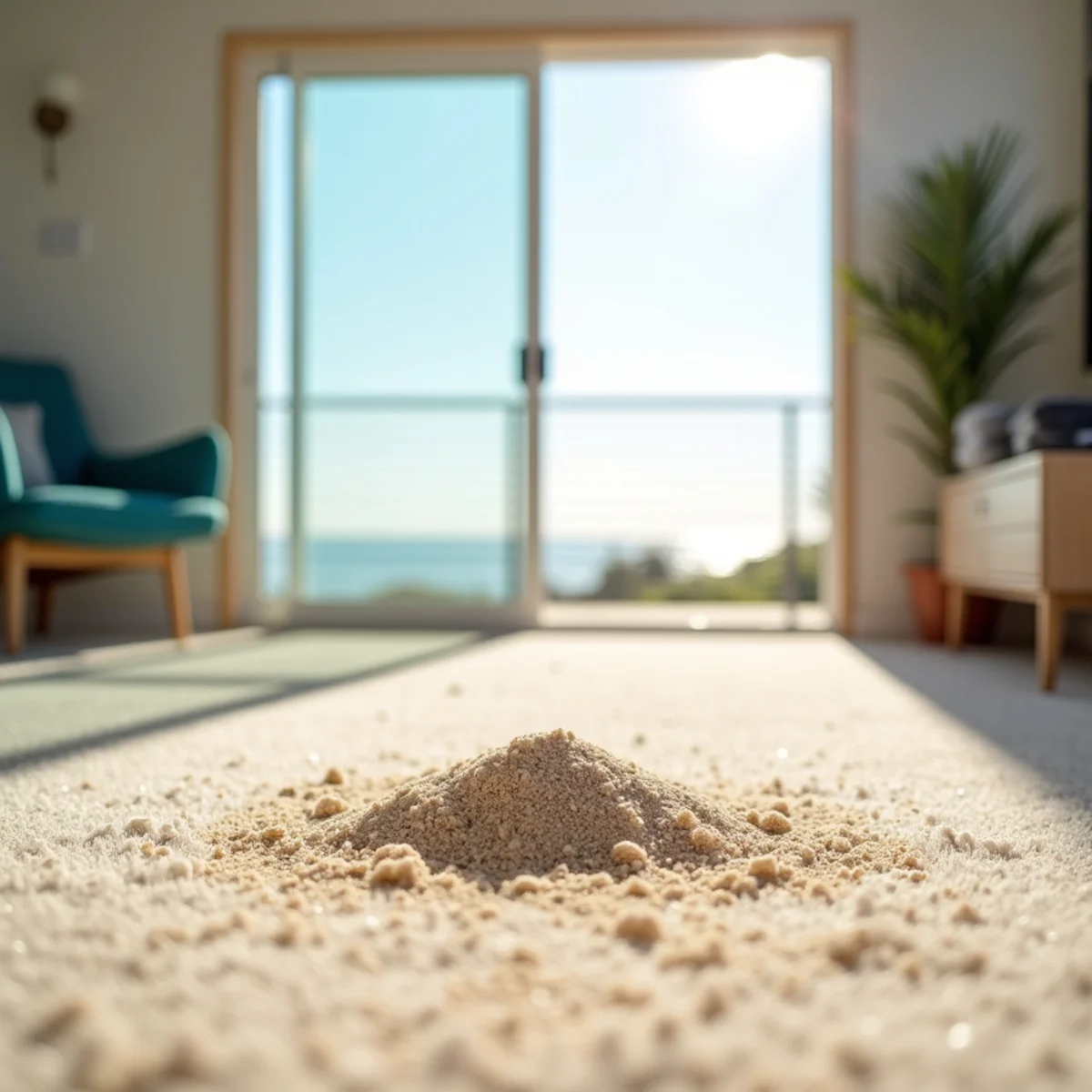
Beach sand is mostly silica — tiny, hard, sharp-edged mineral crystals. When those particles settle deep into your carpet, every footstep presses them against the fibers. The effect is a lot like very fine sandpaper. The abrasive grit scratches and nicks the fiber surface, breaks strands, and flattens the pile over time. That's why traffic lanes near doors and hallways start looking gray and worn long before the rest of the room.
Unlike soft household dust, silica sand particles don't simply brush off. They're heavy and angular, so they work their way down past the visible surface and lodge against the carpet backing. Once they're down there, they keep doing damage with every step until they're physically extracted. This is the hidden reason coastal carpets can wear out faster than the same carpet would in a dry inland home.
The fix isn't to scrub harder — that just drives the grit deeper. It's to lift and remove the sand before it has time to settle and abrade. That starts with smart vacuuming and, eventually, deep extraction that pulls embedded particles out of the base of the pile.
Salt Air, Humidity, and the Mold Connection
Salt is the part of the coastal equation most people overlook. Salt air residue settles onto and into your carpet as a fine, sticky film. Salt is hygroscopic, which means it actively pulls moisture out of the air and holds onto it. So even on a dry-feeling day, salt residue in your carpet keeps things slightly damp and helps dust and dirt cling instead of releasing when you vacuum.
Now add Oceanside's marine layer. That morning fog and the steady sea breeze push relative humidity high, and moisture works its way down into the carpet padding where airflow is poor. Salt holds that moisture in place, sand gives microbes texture to grip, and warm, damp padding becomes a quiet incubator. The result is a clear chain: trapped sand and salt attract and hold moisture, and persistent moisture in the padding can lead to mold and mildew growth.
This is why a beach house can smell musty even when nothing was ever spilled on the carpet. The musty odor is often coming from the padding underneath, not the surface you can see. Breaking that chain means removing the salt and sand and then drying thoroughly — not just cleaning the top layer.
Signs Your Carpet Has Coastal Grit and Salt Buildup
Coastal carpet problems tend to show up gradually, so it helps to know what to look for. Catching them early means easier cleaning and longer carpet life.
- Graying traffic lanes — pathways near entries, hallways, and sliding doors look dull or grayish even right after vacuuming
- A gritty or crunchy feel — running your hand or bare foot across the carpet, you feel sand down in the pile
- A musty or damp odor — especially noticeable in the morning, in closed-up rooms, or near exterior walls
- Carpet that never feels fully clean — it looks vacuumed but still feels coated or sticky from salt residue
- Faster-than-expected wear — matting, flattening, and thinning showing up sooner than the carpet's age would suggest
- Dust that resettles quickly — salt residue holds onto dust and allergens, so surfaces and carpet feel dusty again soon after cleaning
How Sand and Dust Get Into Oceanside Homes
You don't have to live on the sand for this to be an issue. Coastal grit travels surprisingly far inland on the breeze, and daily life carries plenty of it through your door. Knowing the entry points makes prevention much easier.
Foot traffic is the biggest culprit — sand rides in on shoes, flip-flops, and bare feet straight from the beach or the driveway. Beach gear like towels, chairs, boogie boards, and coolers sheds sand all through the house. Open windows and doors invite the sea breeze to deposit fine particles directly onto carpet. Pets are major carriers too: sandy paws and fur track in grit and salt after every walk. And in homes near the water, ocean wind alone keeps a steady supply of fine particles drifting indoors year-round.
Because the supply is constant, the goal isn't to eliminate sand completely — that's not realistic on the coast. The goal is to intercept most of it at the door and remove the rest before it settles deep.
A DIY Routine That Actually Works
Most people vacuum and assume the sand is gone. The problem is that standard vacuuming skims the surface while heavy silica particles sit lower in the pile. A few adjustments make a real difference between cleanings.
The single most effective trick is to agitate before you vacuum. Use a stiff carpet brush or a vacuum's beater bar (on a setting safe for your pile) to lift embedded grit up toward the surface where suction can grab it. Then vacuum with slow passes — moving the vacuum slowly gives the airflow time to actually pull particles up. Quick back-and-forth strokes leave most of the sand behind. Go over high-traffic and near-entry areas several times in different directions.
A few practical guardrails: empty the canister or change the bag often, because sand fills it fast and kills suction. Watch for vacuum overheating — abrasive grit is hard on motors and brushes, so let the machine rest if it smells hot. Pair this with entry mats and doormats at every door and a shoes-off policy inside, and you'll dramatically cut how much sand ever reaches the carpet.
- Brush or agitate the pile first to lift grit, then vacuum
- Use slow, overlapping passes — let suction do the work
- Vacuum high-traffic and entry zones in multiple directions
- Empty the canister or bag frequently to keep suction strong
- Place coarse entry mats at every exterior door and shake them out often
- Keep a shoes-off habit and a spot near the door for sandy beach gear
Why Vacuuming and Store Machines Fall Short
A good DIY routine keeps things manageable, but it has real limits — and it's important to know where they are so you're not fighting a losing battle. Home vacuums simply don't generate enough airflow and suction to extract sand that has worked its way down against the carpet backing. The deepest, most abrasive grit stays put no matter how carefully you vacuum.
Rental and store-bought carpet machines have a different problem. They tend to push a lot of water into the carpet without the suction power to pull most of it back out. In a humid coastal climate, that's the worst possible outcome: you leave the sand behind and add moisture that soaks into the padding. You can end up trading a sand problem for a mildew problem.
Salt residue is also stubborn. It bonds with the fibers and holds moisture, and surface cleaning rarely removes it fully. Genuinely clearing embedded sand and dissolved salt takes professional-grade deep extraction with strong recovery — something home equipment isn't built to do.
How a Coastal Deep Clean Removes Embedded Sand and Salt
Professional cleaning for coastal homes works differently because the problem is different. The approach combines hot water extraction with low-moisture cleaning to remove embedded sand and dissolved salt without over-wetting the carpet — which matters enormously in Oceanside's humid air.
Hot water extraction injects a heated, eco-friendly non-toxic cleaning solution deep into the pile to dissolve salt residue and loosen the bond between grit and fibers, then a powerful vacuum recovers the water along with the suspended sand and salt. The strong recovery is the key part — it pulls particles and moisture back out instead of leaving them behind. Where appropriate, low-moisture methods finish the job using far less water, so the carpet dries faster and stays ahead of the humidity.
This is the heart of a Beach Sand and Salt Extraction service: a coastal-focused process built specifically to clear out the silica and salt that standard cleaning leaves behind. The cleaning solutions used are pet-safe and kid-safe, which matters when little ones and dogs spend their days on the floor. The aim is carpet that feels genuinely clean underfoot, not just freshened on top — and a process that may help reduce dust, allergens, and buildup that coastal living drives into the fibers.
Drying Carpet Safely in a Humid Coastal Climate
In a marine-layer climate, how you dry the carpet matters as much as how you clean it. Leave carpet damp in high relative humidity and you risk the very mold and mildew you were trying to prevent. Proper professional cleaning is built to dry quickly and safely.
Most carpets dry in about two hours after a professional clean, though that's a soft estimate, not a promise — actual drying time varies based on carpet type, airflow, humidity, and cleaning needs. On a heavy marine-layer morning it can take longer. The way to speed it up is airflow: open windows when the air outside is dry, run ceiling and floor fans, and use a dehumidifier to pull moisture out of the room. Air movers and careful moisture control are part of how a good coastal clean finishes the job.
This is also why low-moisture methods earn their place on the coast. Using less water from the start means less to dry, which is the safest path in a humid environment. The goal is always clean and dry — never one without the other.
How Often Oceanside Homes Should Clean Carpets
Because the coast keeps feeding sand and salt into your carpet, frequency matters more here than inland. There's no one-size answer, so a tiered schedule is the most useful way to think about it. These are general guidelines — your own situation may push you faster. Between professional visits, the DIY routine above is what keeps things in check.
- Standard inland Oceanside home (no pets, low traffic): professional cleaning about every 12 months
- Homes with pets or kids: roughly every 6 to 9 months, since sandy paws and active feet drive grit deeper
- Near-beach homes (within a mile or so of the water): about every 6 months to stay ahead of salt and sand
- Vacation rentals, Airbnbs, and high-turnover Camp Pendleton-area homes: every 3 to 6 months, or between major guest turnovers
Rentals, Airbnbs, and Camp Pendleton Turnover Homes
Oceanside has a huge population of vacation rentals, Airbnbs, and military families near Camp Pendleton, and these homes face coastal carpet wear on fast-forward. Guests track in sand without a second thought, beach gear comes and goes daily, and the carpet rarely gets a long rest to dry out between stays.
For rental owners and property managers, carpet condition is part of the guest experience and the review you'll get. Gritty, gray, or musty-smelling carpet reads as unclean even if everything else sparkles. Scheduling extraction between busy seasons or major turnovers keeps the floors presentable and protects your investment from premature wear. Same-week availability makes it easier to fit a clean into a tight changeover window — though we'd always book ahead during peak season when you can.
Military families rotating through PCS moves have their own version of this: move-in and move-out cleaning where coastal grit has built up over a tour. A thorough sand and salt extraction at turnover gets the carpet back to a fresh starting point.
Protecting Wool, Persian, and Oriental Area Rugs
If you have wool, Persian, or Oriental area rugs, the coast is especially tough on them — and they're far more valuable and harder to replace than wall-to-wall carpet. Sand is brutal on wool. Silica grit settles into the dense foundation knots and cuts the fibers from the inside every time someone walks across, which is how a fine rug can develop bald patches and weak spots over years on the coast.
Salt and humidity add their own risk. Trapped moisture in a wool rug can lead to dry rot in the foundation and mildew on the back, and salt residue dulls the colors and stiffens the pile. These rugs need gentler, specialized care than synthetic carpet — never a one-size-fits-all machine clean. Proper rug cleaning controls moisture carefully and dries the rug fully so it doesn't sit damp.
Day to day, rotate rugs periodically so wear and sun fade spread evenly, vacuum gently without an aggressive beater bar on delicate piles, and shake or beat smaller rugs outdoors to release sand from the back. For anything antique, hand-knotted, water-damaged, or genuinely valuable, leave the deep cleaning to specialists who handle Persian and Oriental rug restoration — the cost of a mistake is simply too high.
Prevention Checklist and When to Call a Pro
Keeping sand and salt out year-round comes down to a handful of habits. None are difficult, and together they cut your carpet's coastal workload dramatically.
DIY is enough when you're keeping up with regular grit, freshening between cleanings, and handling small everyday tracking. It's time to call a local Oceanside pro when the carpet feels gritty no matter how you vacuum, when traffic lanes have grayed, when a musty odor sets in, or when you're prepping a rental turnover or a move. Many coastal stains and buildup can be improved or removed depending on type, age, and material — and a coastal-focused deep clean reaches what home equipment can't. When the beach has gotten into your floors faster than your vacuum can keep up, that's the signal to bring in help.
- Coarse entry mats at every door, plus a shake-out routine
- Shoes-off inside, with a bench and basket by the door for beach gear
- A designated rinse or brush-off spot for sandy paws and feet
- Windows closed on windy, high-marine-layer days when sand drifts in
- Agitate-then-vacuum slowly, at least weekly in traffic zones
- A dehumidifier or good airflow to keep padding from staying damp
- Professional extraction on a schedule that fits your home's coastal exposure
Frequently Asked Questions
Does beach sand ruin carpet?
How do you get sand out of carpet?
Why does my carpet feel gritty or crunchy near the beach?
How often should I clean my carpets if I live near the ocean in Oceanside?
Can coastal humidity cause mold in my carpet?
How long does carpet take to dry in a humid coastal climate?
Will vacuuming alone remove sand from carpet?
Need Help With Your Carpets or Rugs?
Always Rug & Upholstery Cleaning serves Oceanside and nearby San Diego County.